
Expectant parents spend months researching prams, car restraints, cots, nappies and feeding equipment. A baby carrier is often added after seeing one recommended online, noticing another parent using one, or receiving one as a gift.
But preparing for babywearing involves more than choosing a popular brand and putting the box aside until the baby arrives.
Ideally, parents should learn about babywearing early enough in pregnancy and before they have invested in a carrier.
This gives them time to handle different styles, try them on, consider what will suit their bodies and lifestyles, and learn the safety principles they will need from their baby’s first days. A free, local babywearing workshop can be an excellent place to begin.
A recent Durham University study surveyed 1,470 parents and caregivers about their use of baby carriers, wraps and slings. Almost nine out of ten had decided to babywear before or during pregnancy, and more than 96 per cent began during their baby’s first three months. Yet many had received little guidance about choosing an appropriate carrier or using one safely.
Parents often turned to social media, websites, friends and manufacturers’ instructions. Many were unaware that specialist babywearing support was available.
The researchers concluded that safety information should be provided during pregnancy and the early postnatal period. It should also be available to fathers, partners, grandparents and anyone else who will regularly carry the baby. The newborn period is when families are most likely to begin using a carrier, but it can also be one of the hardest times to learn an unfamiliar skill. Carrier advertising can suggest that choosing a carrier is simply a matter of selecting a colour, reading the age range on the box, and clicking “add to cart”.
In reality, carriers fit bodies differently.
Parents vary in height, torso length, shoulder shape, mobility and sensitivity to pressure. Some have back, hip, pelvic or shoulder concerns. Some prefer wrapping fabric; others prefer buckles. A carrier comfortable on one parent may feel awkward on their partner.
There is also no single carrier that is best for every newborn.
Some buckle carriers advertised as suitable “from birth” do not fit every newborn immediately. Babies vary in size, proportions, muscle tone and development. Premature and low birth weight babies may need additional assessment before being carried.
Attending a workshop before purchasing allows parents to compare carrier styles without sales pressure. They can explore stretchy and woven wraps, ring slings, soft newborn carriers and adjustable buckle carriers before deciding what to investigate further.
Community babywearing workshops are educational rather than retail events. There are no products to sell and no expectation that parents will buy a carrier on the day.
Do not leave it until the final weeks.
Late pregnancy is still useful for learning, but a large bump can make some waistbands difficult to position and make the fit less representative of how the carrier will feel after birth.
Attending during the middle months gives parents a better opportunity to try carriers against their own bodies.
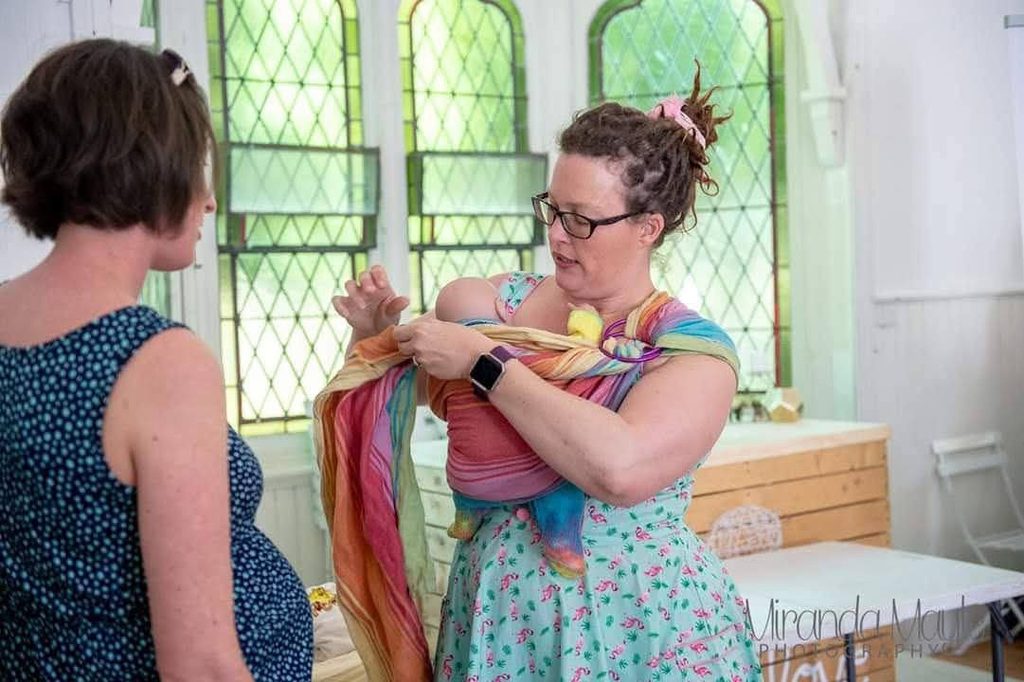
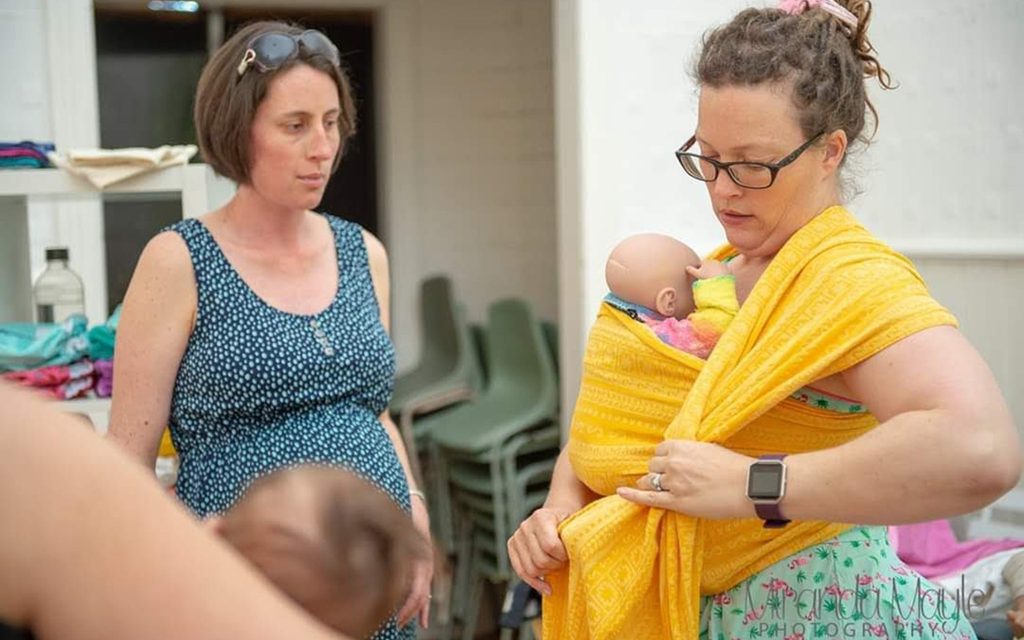
Using a weighted demonstration doll, they can practise putting a carrier on, tightening it correctly and removing the baby safely. Partners and other caregivers can practise too, because each wearer may need different adjustments.
A doll cannot wriggle, cry or suddenly need to feed, but antenatal practice makes the equipment less unfamiliar when the real baby arrives.
Safety is more than T.I.C.K.S.
The T.I.C.K.S. guidelines provide an important starting point:
Tight: The carrier should hold the baby securely. Loose fabric can allow a young baby to slump.
In view at all times: The baby’s face should remain visible and uncovered.
Close enough to kiss: A newborn should be carried high on the wearer’s chest.
Keep the chin off the chest: The baby’s head must not fall forward into a position that restricts the airway.
Supported back: The carrier should support the baby’s body and prevent curling or slumping.
However, the Durham University study found that parents wanted more than an acronym. They wanted practical information about positioning, fit checks, feeding, sleeping, overheating, illness and how long babies could remain in a carrier.
Understanding why positioning matters.
Young babies, particularly those under four months, have relatively large, heavy heads and limited head and neck control. If a baby slumps, their chin can be pushed towards their chest and their airway restricted. Their nose or mouth can also become pressed against fabric or the wearer’s body.
A baby experiencing breathing difficulty might not cry or struggle. They can be silent, which is why safe babywearing requires active monitoring.
Learn what to check every time.
A workshop should teach parents to assess the whole position rather than simply fasten the carrier.
Can you see the baby’s entire face? Are the nose and mouth uncovered? Is the baby upright? Is there space beneath the chin?
Is the carrier tight enough to prevent slumping? Is the back supported? Does the carrier suit the baby’s current size and development? Is the baby becoming too warm?
These checks should be repeated while the carrier is being used. Babies move, straps loosen, clothing shifts and a baby’s position can change after feeding or falling asleep.
When babies sleep in carriers.
Babies commonly fall asleep while being carried. In a well-designed, correctly fitted carrier, a sleeping baby remains high and upright against the wearer, with their face visible, chin away from their chest and back fully supported.
Sleep itself is not the problem. Risks arise when a carrier allows a young baby to slump, curl deeply, drop too low or press their face into fabric or clothing. Loose fabric or straps can allow the baby’s position to change as their muscles relax.
Some harness-style carriers have limited adjustability and cannot be tightened sufficiently around a small baby. They may appear secure because the buckles are fastened while still leaving space for the baby to slump. Other carriers mould closely around the baby and provide more continuous support.
Parents need to assess a carrier rather than relying only on its price, brand, packaging or stated age range.
A sleeping baby should continue to be monitored. Their face should remain visible, nose and mouth uncovered, and head supported in a position that keeps the airway open.
Before buying, parents can learn how different designs support a sleeping newborn, how securely a carrier should fit and what to check when a baby relaxes into sleep. This helps them make a more informed choice before investing.
Feeding in a carrier.
Feeding in a carrier is not a hands-free activity. Breastfeeding in a carrier is usually easier to explore once feeding is established and the baby has greater head and neck control. The baby must be supported with the wearer’s hands during the feed.
Afterwards, the baby needs to be returned to a high, upright position with their face visible and airway clear. A temporary feeding position is not the position in which the baby should continue to be carried.
These are useful points to discuss before parents are tired and facing a crying newborn.
Come back after birth.
An antenatal workshop provides preparation, but it cannot replace support with the individual baby.
Once the baby arrives, parents can return for a fit check. An educator can confirm that the carrier suits the baby’s actual size and development, help position the baby and adjust the carrier for the recovering parent’s body.
This can be especially useful after a caesarean birth or when a parent has pelvic, back, shoulder or mobility difficulties.
Carriers also need to be readjusted as babies grow. Newborn settings will not remain appropriate throughout infancy.
Local support without a sales pitch.
Families on the Mornington Peninsula and across Melbourne’s south-east can attend free community babywearing workshops through South Eastern Babywearing Group.
Parents are welcome during pregnancy, preferably before purchasing a carrier. They can explore different styles, practise with demonstration dolls, learn safe positioning and think realistically about what may suit their family. There are no products for sale. The purpose is education, preparation and support.
After the baby arrives, families can attend again with their carrier and baby for help in achieving a safe, comfortable fit.
A carrier is not simply another item to tick off the shopping list. Learning how to choose one, monitoring a young baby and finding support matters just as much.
Yvette O’Dowd is not your typical grandmother! This mother of three and ‘Granny’ of three has been a breastfeeding counsellor since 1992. In 2014, Yvette established the Southern Natural Parenting Network, incorporating South Eastern Babywearing Group. With 11,000 members world-wide, the group supports parents interested in breastfeeding, babywearing, co-sleeping, baby-led weaning and modern cloth nappies and other aspects of gentle, natural parenting.
www.facebook.com/SouthernNaturalParentingNetwork